In Ghostly Japan by Michael Dylan Foster
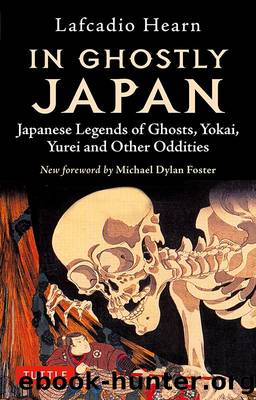
Author:Michael Dylan Foster
Language: eng
Format: epub
Publisher: Tuttle Publishing
FOOTPRINTS OF THE BUDDHA
FOOTPRINTS OF THE BUDDHA
I
I WAS recently surprised to find, in Andersonâs catalogue of Japanese and Chinese paintings in the British Museum, this remarkable statement: â âIt is to be noted that in Japan the figure of the Buddha is never represented by the feet, or pedestal alone, as in the Amravâtî remains, and many other Indian artrelics.â As a matter of fact the representation is not even rare in Japan. It is to be found not only upon stone monuments, but also in religious paintings, â especially certain kakémono suspended in temples. These kakémono usually display the footprints upon a very large scale, with a multitude of mystical symbols and characters. The sculptures may be less common; but in Tokyo alone there are a number of âButsu-soku-séki, or âBuddha-foot stones,â which I have seen, â and probably several which I have not seen. There is one at the temple of EkÅ-In, near RyÅgoku-bashi; one at the temple of Dentsu-In, in Koishikawa; one at the temple of DenbÅ-In, in Asakusa; and a beautiful example at ZÅjÅji in Shiba. These are not cut out of a single block, but are composed of fragments cemented into the irregular traditional shape, and capped with a heavy slab of Nebukawa granite, on the polished surface of which the design is engraved in lines about one-tenth of an inch in depth. I should judge the average height of these pedestals to be about two feet four inches, and their greatest diameter about three feet. Around the footprints there are carved (in most of the examples) twelve little bunches of leaves and buds of the Bodai-jÅ« (âBodhidrumaâ), or Bodhi tree of Buddhist legend. In all cases the footprint design is about the same; but the monuments are different in quality and finish. That of ZÅjÅji, â with figures of divinities cut in low relief on its sides, â is the most ornate and costly of the four. The specimen at EkÅ-In is very poor and plain.
The first âButsu-soku-séki made in Japan was that erected at TÅdaiji, in Nara. It was designed after a similar monument in China, said to be the faithful copy of an Indian original. Concerning this Indian original, the following tradition is given in an old Buddhist book1: â âIn a temple of the province of Makada [Maghada] there is a great stone. The Buddha once trod upon this stone; and the prints of the soles of his feet remain upon its surface. The length of the impressions is one foot and eight inches,2 and the width of them a little more than six inches. On the sole-part of each footprint there is the impression of a wheel; and upon each of the prints of the ten toes there is a flower-like design, which sometimes radiates light. When the Buddha felt that the time of his Nirvana was approaching, he went to Kushina [Kusinârâ], and there stood upon that stone. He stood with his face to the south. Then he said
Download
This site does not store any files on its server. We only index and link to content provided by other sites. Please contact the content providers to delete copyright contents if any and email us, we'll remove relevant links or contents immediately.
| Anthologies | British & Irish |
| Dark Fantasy | Erotic Horror |
| Ghosts | Occult |
| Reference | United States |
| Vampires |
In Control (The City Series) by Crystal Serowka(36187)
The Wolf Sea (The Oathsworn Series, Book 2) by Low Robert(35191)
We Ride Upon Sticks by Quan Barry(34484)
Crowbone (The Oathsworn Series, Book 5) by Low Robert(33574)
The Book of Dreams (Saxon Series) by Severin Tim(33336)
The Daughters of Foxcote Manor by Eve Chase(23563)
Trainspotting by Irvine Welsh(21577)
Call Me by Your Name by André Aciman(20441)
The Secret History by Donna Tartt(18953)
Shot Through The Heart (Supernature Book 1) by Edwin James(18888)
All the Missing Girls by Megan Miranda(15793)
The Girl from the Opera House by Nancy Carson(15752)
American King (New Camelot #3) by Sierra Simone(15651)
Pimp by Iceberg Slim(14441)
Sad Girls by Lang Leav(14367)
The Betrayed by Graham Heather(12789)
The Betrayed by David Hosp(12734)
4 3 2 1: A Novel by Paul Auster(12336)
Still Me by Jojo Moyes(11227)
